
Register Contact For patients
Coloplast Professional
  • Stoma

    E-learning

    E-learning

    Webinars on-demand

    Webinars on-demand

    Videos

    Prevention Guide

    Mentorship Programme

    Mentorship Programme

    Knowledge hub

    Apollo Paediatric ostomy Foundations in Motivational Interviewing

    Short reads

    Short reads

    Articles and Publications

    Articles and Publications

    Validated Tools

    Validated Tools

    Event calendar

    Event calendar

    Webinars

    Webinars

    Face to Face Events

    Face to Face Events

    Podcasts

    Podcasts

    All resources

    All resources

    Fit tool

    Fit tool

    Patient resources

    Educational Videos Instructional Videos

    Coloplast Charter

    Coloplast Charter

    All Ostomy Products

    All Ostomy Products

    SenSura Mio

    SenSura® Mio Concave SenSura® Mio in Black

    Supporting Products

    Heylo Brava Protective Seal
  • Bladder

    E-learning

    E-learning

    Webinars on-demand

    Webinars on-demand

    Podcasts

    Podcasts

    UTI Risk Factors Model

    UTI Risk Factors Model

    Short reads

    Short reads

    Articles and Publications

    Articles and Publications

    Validated Tools

    Validated Tools

    Neurogenic

    Neurogenic

    Event calendar

    Event calendar

    Webinars

    Webinars

    Face to Face Events

    Face to Face Events

    Patient assessment

    Patient assessment

    Patient resources

    Educational videos Instructional Videos

    Coloplast Charter

    Register an IC Patient Urine Drainage Patient Registration Coloplast Charter

    All Bladder Products

    All Bladder Products

    Luja

    Luja Female Luja Male
  • Bowel

    E-learning

    E-learning

    Webinars on-demand

    Webinars on-demand

    Podcasts

    Podcasts

    Knowledge hub

    LARS MENTOR Tool Foundations in Motivational Interviewing

    Articles and Publications

    Articles and Publications

    Validated Tools

    Validated Tools

    Tai Treatment Guide

    Tai Treatment Guide

    Event calendar

    Event calendar

    Webinars

    Webinars

    Face to Face Events

    Face to Face Events

    Patient services

    Patient services

    Peristeen® - Registering patients to Charter or Referring to the

    Peristeen® - Registering patients to Charter or Referring to the Coloplast Nursing Service

    All Bowel Products

    All Bowel Products

    Peristeen

    Peristeen® Light Peristeen Light Portfolio Peristeen Plus
  • Wound

    E-learning

    E-learning

    Knowledge

    Everything you need to know about wound care Wound preparation Wound assessment Wound healing Exudate management Wound types Infection and biofilm

    Podcasts

    Podcasts

    Patient cases

    Patient cases

    Clinical videos

    Clinical videos

    Scientific publications

    Scientific publications

    Event calendar

    Event calendar

    Webinars

    Webinars

    Tools for professionals

    Tools for professionals

    Tools for patients

    Tools for patients

    All wound dressings

    All wound dressings

    Non-infected wounds

    Non-infected wounds

    Infected wounds

    Infected wounds

    Painful wounds

    Painful wounds

    Types of dressing

    Silicone foam dresssings Foam dressings Silver dressings Hydrocolloid dressings Contact layer dressings Gelling fiber dressings
  • Interventional Urology

    Erectile restoration

    Clinical Evidence Clinical Learning E-learning

    Male continence

    Clinical Evidence Clinical Learning E-learning

    Female Continence

    Clinical Evidence Clinical Learning E-learning

    Pelvic Floor Reconstruction

    Clinical Evidence Clinical Learning E-learning

    Stone Management

    Clinical Evidence Clinical Learning E-learning

    Soft Tissue Management

    Clinical Evidence Clinical Learning E-learning

    BPH

    Clinical Evidence Clinical Learning E-learning

    Upcoming Events
Log in
Coloplast Professional
New Mobile navigation Shopping basket Shopping basket Shopping basket Print Icon Icon / delete Temp Info

This site is intended for Healthcare Professionals only. The site content is intended for informational- and educational purposes and may not be appropriate for all jurisdictions. Coloplast does not provide medical advice. Responsibility for patient care resides with the health care professional. For detailed device information on products presented, including instructions for use, contraindications, effects, precautions and warnings, please consult the product’s Instructions for Use (IFU) prior to use.

Yes, I am a health care professional No, I am not a health care professional

The role of the skin

The skin’s structure plays a crucial role in wound healing. So, when we want to assess and manage wounds effectively, it’s important that we understand how the skin structure works.8 

How does the skin work?

The skin's most important function is to protect our body from harm.

For example, the skin protects us from trauma, toxins, ultraviolet light and microorganisms. It also keeps us from getting dehydrated and helps our body maintain the right temperature.

Epidermis

The epidermis is the visible part of the skin – its outermost layer. The epidermis is relatively thin, ranging in thickness from 0.05 mm on our eyelids, to 1.5 mm on the palms our hands and the soles of our feet.8

This layer of skin is made up of four layers.

The top layer, the stratum corneum, is renewed about every 15 days in individuals with healthy skin.
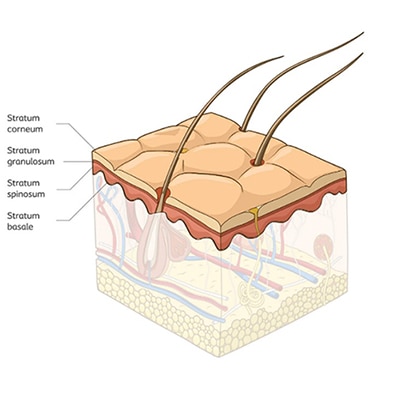
The epidermis

What does the epidermis do?

The epidermis has three types of cells, each with a specific function: 

  • Keratinocytes - The majority of the cells in the epidermis (95%) are keratinocytes. These cells retain moisture, which helps the skin act as a barrier.33  
  • Melanocytes - These cells give skin its colour, or pigment. They also protect the skin from ultraviolet (UV) light.33 
  • Langerhans cells - These cells are a part of the immune system. They protect the body from potential allergens, bacteria and toxic substances by triggering an immune response.10,33  

The three types of skin cells in the epidermis

These cells each play a roe in the epidermis' three vital functions:

  • to act as a barrier
  • to control water loss
  • to protect our bodies from UV light, bacteria and allergens. 1, 8

Why is it important?

The epidermis is a highly specialised structure that adapts to the world around us. It provides a physical and chemical barrier that protects the body by:

  • preventing foreign substances from entering the body; and
  • triggering the body’s immune system when any pathogens break through the barrier.18,26


What is the dermis?

The dermis is the middle layer of the skin. It’s approximately 15-40 times thicker than the epidermis. The dermis contains nerve endings; blood vessels; and skin appendages, such as hair follicles, sebaceous glands and sweat glands.4,33

What does it do?

The dermis is responsible for many of the skin’s important functions. For example, it’s where we feel sensation, such as pain and temperature.

The dermis also contains the glands that secrete sebum, which helps the skin maintain the right moisture balance. And sebum and sweat combine to create an acidic environment on our skin, known as the “acid mantle”.33

Why is it important?
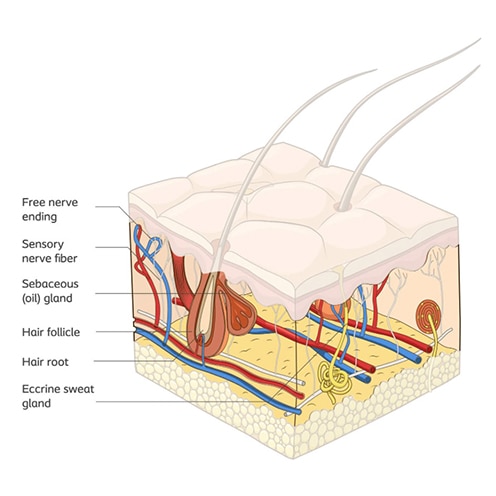
The dermis

The dermis plays an important role in maintaining the skin’s moisture and pH balance. This balance helps to prevent infection. In full-thickness wounds (wounds, such as pressure injuries, that penetrate all three skin layers), the dermis is lost. That’s why these wounds take a long time to heal because the tissue repair process is so complex.19,25

Once they do heal, the structures within the dermis, such as the sweat glands and hair follicles, are permanently lost.25

Did you know?

When a wound heals, the dermis doesn’t have the same structure and function 

as it does in undamaged skin. This is because the dermis is replaced by scar tissue, as you can see in this image.25


The Subcutaneous tissue

What is it?

The subcutaneous tissue, also known as subcutis, is the lower layer of the skin. This layer contains connective and fatty tissue as well as major blood vessels and nerves.33 The thickness of the subcutis depends on several factors,
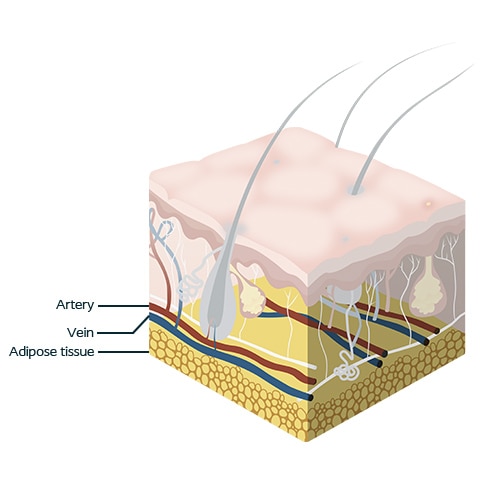
The Subcutaneous tissue

 including where it is on the body and the person’s age.

What does it do?

The subcutis insulates our bodies. It acts as a cushion, protecting the internal organs from external pressure. It also plays a role in helping the body retain moisture.33  

Why is it important? 

The subcutaneous tissue is essential precisely because of its role in insulating and padding the body. In this way, it works to protect our bones, muscles, and the organs under the skin from physical damage. 


Explore topics

Wound Healing Moist wound healing
  • The information, views and opinions expressed at this site and in the materials presented are solely those of the individuals involved and do not necessarily represent those of Coloplast A/S or its affiliates (“Coloplast”). Coloplast is not responsible and does not verify the accuracy of any of the information or material presented at the site. The information presented may not be appropriate for all jurisdictions.
    Read the full disclaimer
  • 0800 220 622
  • CProfessionalUK@coloplast.com
  • mktcoloplastiu@coloplast.com - IU contact
  • Coloplast Ltd Nene Hall, Peterborough Business Park PE2 6FXPeterborough United Kingdom
    • Cookie policy
    • Legal Aspects
    • Privacy Notice
    • Coloplast products - instructions for use
    • Modern Slavery Act
    • EU Declarations of conformity
    • Accessibility