Register Contact For patients
Coloplast Professional
  • Stoma

    E-learning

    E-learning

    Webinars on-demand

    Webinars on-demand

    Videos

    Prevention Guide

    Mentorship Programme

    Mentorship Programme

    Knowledge hub

    Apollo Paediatric ostomy Foundations in Motivational Interviewing

    Short reads

    Short reads

    Articles and Publications

    Articles and Publications

    Validated Tools

    Validated Tools

    Event calendar

    Event calendar

    Webinars

    Webinars

    Face to Face Events

    Face to Face Events

    Podcasts

    Podcasts

    All resources

    All resources

    Fit tool

    Fit tool

    Patient resources

    Educational Videos Instructional Videos

    Coloplast Charter

    Coloplast Charter

    All Ostomy Products

    All Ostomy Products

    SenSura Mio

    SenSura® Mio Concave SenSura® Mio in Black

    Supporting Products

    Heylo Brava Protective Seal
  • Bladder

    E-learning

    E-learning

    Webinars on-demand

    Webinars on-demand

    Podcasts

    Podcasts

    UTI Risk Factors Model

    UTI Risk Factors Model

    Short reads

    Short reads

    Articles and Publications

    Articles and Publications

    Validated Tools

    Validated Tools

    Neurogenic

    Neurogenic

    Event calendar

    Event calendar

    Webinars

    Webinars

    Face to Face Events

    Face to Face Events

    Patient assessment

    Patient assessment

    Patient resources

    Educational videos Instructional Videos

    Coloplast Charter

    Register an IC Patient Urine Drainage Patient Registration Coloplast Charter

    All Bladder Products

    All Bladder Products

    Luja

    Luja Female Luja Male
  • Bowel

    E-learning

    E-learning

    Webinars on-demand

    Webinars on-demand

    Podcasts

    Podcasts

    Knowledge hub

    LARS MENTOR Tool Foundations in Motivational Interviewing

    Articles and Publications

    Articles and Publications

    Validated Tools

    Validated Tools

    Tai Treatment Guide

    Tai Treatment Guide

    Event calendar

    Event calendar

    Webinars

    Webinars

    Face to Face Events

    Face to Face Events

    Patient services

    Patient services

    Peristeen® - Registering patients to Charter or Referring to the

    Peristeen® - Registering patients to Charter or Referring to the Coloplast Nursing Service

    All Bowel Products

    All Bowel Products

    Peristeen

    Peristeen® Light Peristeen Light Portfolio Peristeen Plus
  • Wound

    E-learning

    E-learning

    Knowledge

    Everything you need to know about wound care Wound preparation Wound assessment Wound healing Exudate management Wound types Infection and biofilm

    Podcasts

    Podcasts

    Patient cases

    Patient cases

    Clinical videos

    Clinical videos

    Scientific publications

    Scientific publications

    Event calendar

    Event calendar

    Webinars

    Webinars

    Tools for professionals

    Tools for professionals

    Tools for patients

    Tools for patients

    All wound dressings

    All wound dressings

    Non-infected wounds

    Non-infected wounds

    Infected wounds

    Infected wounds

    Painful wounds

    Painful wounds

    Types of dressing

    Silicone foam dresssings Foam dressings Silver dressings Hydrocolloid dressings Contact layer dressings Gelling fiber dressings
  • Interventional Urology

    Erectile restoration

    Clinical Evidence Clinical Learning E-learning

    Male continence

    Clinical Evidence Clinical Learning E-learning

    Female Continence

    Clinical Evidence Clinical Learning E-learning

    Pelvic Floor Reconstruction

    Clinical Evidence Clinical Learning E-learning

    Stone Management

    Clinical Evidence Clinical Learning E-learning

    Soft Tissue Management

    Clinical Evidence Clinical Learning E-learning

    BPH

    Clinical Evidence Clinical Learning E-learning

    Upcoming Events
Log in
Coloplast Professional
New Mobile navigation Shopping basket Shopping basket Shopping basket Print Icon Icon / delete Temp Info

What is wound infection?

A wound is considered infected when microorganisms that damage local tissue and delay wound healing are present.1

The presence of microorganisms triggers an immune response in the patient. Whether or not this response is successful depends on a balance of two things:

  • the strength of the patient’s immune system; and
  • the amount and virulence of the pathogens.

What causes wound infection?

When the amount and virulence of the pathogens are too much for the patient’s immune system to handle, the wound becomes infected.2

What role do microorganisms play in a wound?

It’s important to note that all wounds contain microorganisms, and their presence does not necessarily mean the wound is infected. Wound infection occurs when microorganisms move deeper into the wound tissue and proliferate leading to local and / or systemic immune response.

Keep in mind that:

  • a wound’s bacterial status can change depending on local, environmental and systemic factors; and
  • the transition from non-infected to infected wounds is often gradual.

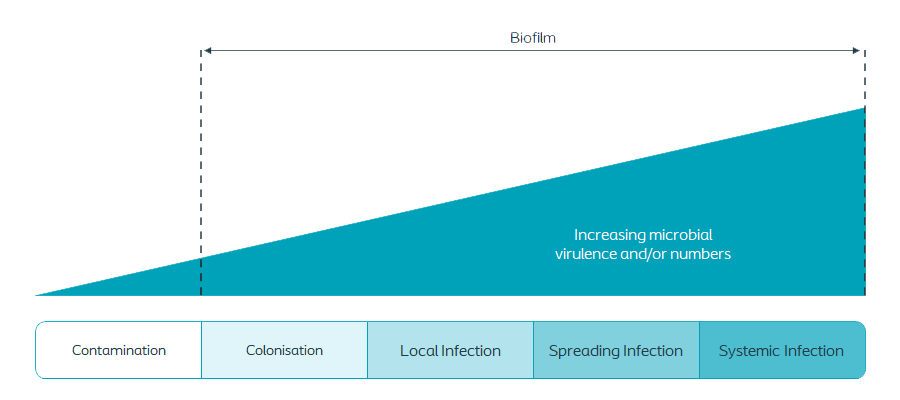
Stages in wound infection

Contamination: The wound is considered contaminated when non-proliferating microorgganisms are present.1

In a contaminated wound:

  • The host defence destroys the microorganisms
  • There are no specific clinical signs / symptoms of infection6
  • There is a steady state of microorganisms5

Colonisation

  • The microorganisms in the wound undergo limited proliferation no significant host response 1
  • The bacteria grow and multiply at a non-critical level, not damaging tissue and having no significant effect on wound healing 1,5

Local Infection

  • The microorganisms proliferate and move deeper into the wound bed and tissue causing a host response1
  • The response is localised in one location, system or structure1
  • Microorganisms in the wound are multiplying5
  • The signs and symptoms are subtle, but may develop into classic symptoms of infection1
Subtle symptoms1 Classic symptoms infection1
  • Hyper-granulation
  • Bleeding
  • Epithelial bridging/pocketing
  • Wound breakdown
  • Delayed healing
  • Increased malodour & pain
  •  Erythema
  • Heat
  • Swelling
  • Purulent discharge
  • Delayed wound healing
  • Pain & malodour


Spreading Infection

  • Microorganisms are present within the wound and are proliferating and invading the surrounding tissues 1
  • The patient1 will show subtle as well as classic symptoms and may also demonstrate early systemic infection indicators 

Systemic Infection

  • Systemic infection from a wound affects the body as a whole, with microorganisms spreading throughout the body via the vascular or lymphatic systems 1
  • Signs and symptoms of systemic infection are:1
    • Sepsis
    • Organ dysfunction
    • Systemic inflammatory response

Wound Infection Continuum

How do you treat an infection?

If you suspect an infection, your immediate goal is to reduce the bioburden in the wound.3 You can do this by:

  • therapeutic cleansing of the wound at each dressing change;
  • aggressive debriding the surface substance and underlying non-viable or unhealthy tissue. This will disrupt the microbial burden and prevent biofilmfrom reoccurring;3 and
  • monitor the wound’s progress and reassess it continually to see if the wound is meeting your treatment goals. You should do this at least once a week or, optimally, at each dressing change.4

What are the clinical signs of wound infection?

In the chart, you’ll see a list of the clinical signs and symptoms of local and systemic infections that you need to look out for when assessing the wound.2:

Signs of local infection Signs of systemic infection
  • Increased pain
  • Erythema
  • Oedema
  • Local warmth
  • Increased exudate
  • Delayed healing
  • Friable granulation
  • Wound odour
  • Pocketing
  • Increased erythema
  • Pyrexia (fever)
  • Abscess / pus
  • Wound breakdown
  • Cellulitis
  • General malaise
  • Raised WBC count
  • Lymphangitis


If a wound still shows these signs of infection after it has been managed correctly and the patient has received appropriate health support, biofilm may be present.

Reducing the risk of wound infection

  • Early identification and treatment to reduce or eliminate infection is clinically and economically beneficial to facilitate wound healing and reduce the impact on the patient and on healthcare systems.
  • A holistic and collaborative approach is vital to the delivery of best practice.
  • Collaborating with the patient in care decisions can help reduce the physical and psychosocial impacts of wound infection.
  • Identifying the risk factors through assessment and then addressing them through education with the patient are essential.

A comprehensive wound infection prevention and treatment plan should develop from a holistic assessment and should address:

  • Optimising the individual host response
  • Reducing local microbial burden
  • Promoting a positive environment for wound healing

Who is at risk of a wound infection?

Development of a wound infection is multifactorial and occurs when the cumulative risk factors overwhelm the host defence system.1

Factors that debilitate the patient, impair immune response or reduce tissue perfusion increase the risk of infection.5

Individual Environmental
  • Poorly controlled diabetes
  • Prior surgery
  • Medications
  • Conditions associated with hypoxia or poor tissue perfusion
  • Immune system disorders
  • Inappropriate antibiotic prophylaxis
  • Protein-energy malnutrition
  • Alcohol, smoking & drug abuse
  • Hospitalisation
  • Unhygienic environment
  • Poor hygiene & aseptic technique
  • Inadequate pressure off-loading
  • Repeated trauma, such as inappropriate dressing removal
  • Inadequate management of moisture, exudate & oedema


To combat the above individual factors, its important to create your optimal host response.  You can do this in the following ways.

  • Managing comorbidity (diabetes, enhance tissue oxygenation / perfusion)
  • Optimise nutritional status & hydration
  • Seek and treat other sites of infection
  • Provide systemic antimicrobial if necessary
  • Manage pain & fever
  • Educate patient & carer
  • Ensure psychosocial support
  • Ensure patient cooperation
  • Minimise or eliminate risk factors

To combat the above environmental factors, consider the following measures.

  • Provide wound care in a clean environment
  • Determine the appropriate aseptic technique based on risk assessment of the patient, wound and environment
  • Provide patient and carer education
  • Review policies and procedures
  • Store equipment appropriately
  • The information, views and opinions expressed at this site and in the materials presented are solely those of the individuals involved and do not necessarily represent those of Coloplast A/S or its affiliates (“Coloplast”). Coloplast is not responsible and does not verify the accuracy of any of the information or material presented at the site. The information presented may not be appropriate for all jurisdictions.
    Read the full disclaimer
  • 0800 220 622
  • CProfessionalUK@coloplast.com
  • mktcoloplastiu@coloplast.com - IU contact
  • Coloplast Ltd Nene Hall, Peterborough Business Park PE2 6FXPeterborough United Kingdom
    • Cookie policy
    • Legal Aspects
    • Privacy Notice
    • Coloplast products - instructions for use
    • Modern Slavery Act
    • EU Declarations of conformity
    • Accessibility